
Cooling Towers
Solutions for Complex Facilities Across the United States
Engineered for Industrial Performance, Reliability & Long-Term Durability
Engineering & Manufacturing Together
YWCT designs and manufactures durable, high‑performance cooling tower solutions engineered for the demanding conditions of industrial cooling. With decades of experience across both modular and large field‑erected systems, we combine advanced fiberglass construction, precise engineering, and efficient installation practices to deliver reliable cooling performance with minimal operational disruption.
Whether adapting to existing site conditions or supporting major new installations, YWCT provides proven, long‑lasting solutions built to meet complex industrial requirements.
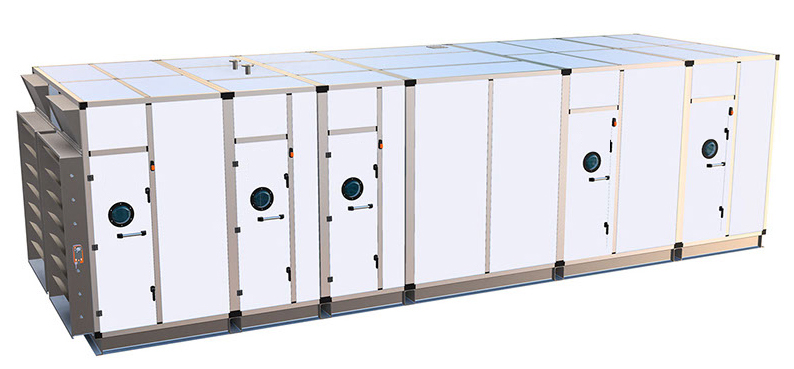
An Air Handling Unit (AHU) is a large metal box-shaped device that regulates and circulates air as part of a heating, ventilating, and air-conditioning (HVAC) system. It collects, filters, heats or cools, and dehumidifies air before distributing it throughout a building via ductwork.
AHUs act as the “heart” of central air conditioning, often installed on roofs or in mechanical rooms. AHUs are essential for maintaining, filtering, and controlling the temperature of the air in large, occupied indoor spaces.
AHU dampers and vacuum brakes are two entirely different technologies used for controlling airflow in HVAC systems and controlling motion in transportation/industrial machinery, respectively.
They control indoor air quality, temperature, and ventilation by balancing air intake and exhaust. AHU dampers control how much air moves through a building’s heating and cooling system, while vacuum brakes use air pressure differences to control the movement of heavy machinery or trains.
AHU (Air Handling Unit) filtration is the process of cleaning air within a centralized HVAC system, using filters to remove pollutants, dust, and microorganisms from outdoor air and recirculated indoor air before it is distributed throughout a building. It serves as the primary barrier for indoor air quality and protects HVAC components.
he main goal is to improve indoor air quality (IAQ) by trapping contaminants such as dust, pollen, mold spores, and bacteria, and to keep the HVAC system clean for better efficiency. Filters are located inside the AHU, usually positioned before the heating/cooling coils and fan to treat air before it enters the building’s ductwork.
An AHU (Air Handling Unit) heating coil is a heat exchanger component within an air handling unit designed to increase the temperature of air as it passes through the system before being distributed throughout a building. These coils heat air using sources like hot water, steam, or electric resistance, ensuring comfortable indoor temperatures.
AHU Heating Coils raise the air temperature to a set point, often used for comfort heating or reheating air that has been over-cooled for dehumidification. These coils are critical for climate control in medium to large commercial or industrial buildings.
An Air Handling Unit (AHU) is a central HVAC component that conditions and circulates air within a building as part of a larger heating, ventilation, and air conditioning system. It draws in fresh outdoor air, filters it, heats or cools it, and controls humidity, before distributing it through ductwork throughout the building.
AHU Ventilation provides healthy indoor air quality by managing fresh air, filtering out particulates, and controlling temperature and humidity. AHUs are often called “ventilation units” because they represent the primary equipment for air movement and renewal in buildings.
AHU silencers, also known as sound attenuators or duct mufflers, are acoustic components installed in heating, ventilation, and air conditioning (HVAC) systems to reduce noise generated by air handling units (AHUs). They are typically installed directly upstream or downstream of the fan to mitigate noise from air movement, vibration, and mechanical operation.
AHU Silencers prevent noise from traveling through ductwork into occupied spaces such as offices, hospitals, and residential buildings. Their effectiveness is determined by insertion loss (noise reduction), pressure drop (airflow resistance), and self-generated noise.
An Air Handling Unit (AHU) base, often called an AHU curb, mounting base, or housekeeping pad, is the structural foundation upon which an air handling unit rests. It provides necessary support, ensures proper airflow clearance, and often helps manage vibration, typically positioning the unit on rooftops, in mechanical rooms, or on concrete floors.
AHU Bases distribute the weight of the large, metal AHU housing evenly, preventing damage to the roof or floor. They provides necessary height for access to lower-level components and piping connections.
An AHU floor (or AHU room/area) is a designated space in a building, often a mechanical room, basement, or rooftop. housing one or more large Air Handling Units (AHUs). These units filter, heat, cool, and circulate air throughout specific zones or the entire building, acting as the heart of the central HVAC system.
AHUs manage air quality and climate control, taking in outside air and return air to provide comfort and ventilation. These rooms or floors are often designed with sound insulation to mitigate the noise from high-powered fans.
An Air Handling Unit (AHU) is a large, metal box-shaped device used in HVAC systems to condition and circulate air within buildings. Its structure is modular, usually consisting of a fan, filters, heating/cooling coils, and dampers, designed to regulate temperature, humidity, and air purity by pulling in fresh air, treating it, and distributing it via ductwork.
The outer casing, often modular (split) to allow for customization, containing all components. AHUs are essential for maintaining indoor air quality and comfort in large commercial spaces, hospitals, and factories.
AHU panels are the modular, insulated “sandwich” panels that form the exterior casing or housing of an Air Handling Unit (AHU). These panels protect internal components (fans, coils, filters) and provide thermal/acoustic insulation to ensure energy efficiency in HVAC systems. They typically consist of double-skin metal with insulation between, often on roofs or in utility rooms.
Our AHU Panels are usually a “double skin” design, comprised of aluminum. These panels allow the AHU to operate efficiently by maintaining a stable internal climate, preventing condensation, and reducing noise in industrial and commercial building setups.
Air Handling Unit (AHU) doors are specialized access panels on HVAC units that provide secure, insulated, and airtight entry for inspecting and maintaining internal components like filters, coils, and fans. These doors are crucial for energy efficiency, noise reduction, and safety, allowing technicians to quickly service the equipment.
Designed for quick entry to interior components, or AHU units feature durable hinges and latching mechanisms. Available in various types tailored for specific needs, such as hinged, removable, or specialized sizes for large units.
Custom Cooling Tower Solutions
Modular Cooling Tower (2,500 – 9,000 GPM)
YWCT brings more than 60 years of cooling‑tower expertise, including over three decades of experience utilizing advanced pultruded FRP construction. Our towers are engineered for long‑term durability in demanding industrial environments and can be custom‑fit to existing concrete basins for fast, low‑disruption replacement projects. Delivered to the site in modular sections, installation can often be completed in just a few days instead of weeks. Available in both counterflow and crossflow configurations, YWCT’s solutions provide reliable, corrosion‑resistant performance for a wide range of industrial cooling needs.
- Certified Performance: Our towers are engineered to meet the highest industry standards and are currently CTI certified per STD-201 (Pending).
- Advanced Materials: Constructed from pultruded FRP (Fiberglass Reinforced Polyester), our towers offer a superior strength-to-weight ratio. They are naturally corrosion-resistant and secured using high-grade Stainless Steel (SS) hardware.
- Integral Basin: Unlike many competing solutions, YWCT’s modular towers feature an integrated FRP basin with a depth of up to 3.5 feet, providing a robust, leak-proof foundation.
Field Erected Cooling Tower (4,500 – 450,000 GPM)
YWCT offers heavy‑duty field‑erected cooling tower solutions engineered to meet the highest industrial heat‑load demands. With decades of experience in large‑scale fiberglass construction, our field‑erected towers are built to perform in the harsh, wet, and corrosive environments typical of industrial cooling. We custom‑engineer each system to match existing concrete basins and footprints, enabling efficient replacement of aging structures with minimal downtime. Designed for both new construction and retrofit applications, YWCT delivers reliable, long‑term cooling performance across a wide range of industrial facilities.
- Custom Fit & Rapid Replacement: YWCT engineers each tower to align precisely with existing concrete basins and site footprints, streamlining retrofits and enabling swift transitions with minimal operational disruption.
- Heavy‑Duty FRP Construction: Built from continuous pultruded FRP sections, our field‑erected towers provide exceptional strength, corrosion resistance, and UV stability—ensuring long‑term structural integrity in demanding industrial environments.
- Scalable, Large‑Format Designs: With single‑cell sizes ranging from 20′ x 20′ to 52′ x 52′, our towers accommodate cooling duties from 4,500 GPM up to 450,000 GPM, supporting both new builds and large‑scale industrial upgrades with efficient on‑site execution.
Custom-Engineered Solutions
Every cooling tower system is tailored to the project’s specific cooling load, site requirements, basin dimensions, and operational goals.

Industry Experience You Can Trust
With over six decades of cooling tower engineering experience and more than 30 years specializing in advanced pultruded FRP construction, YWCT delivers proven cooling solutions for critical industrial applications.

Fast Installation & Reduced Downtime
Our modular construction approach allows for rapid on-site assembly and streamlined replacement projects, helping facilities reduce downtime and operational disruption.

Engineered for reliability, efficiency, and flexibility, our systems are designed to meet the demanding performance standards of critical and controlled environments.